
A2 Portuguese for Residency: What Level Do You Actually Need?
Published 27 August 2026
Somewhere between booking your visa appointment and unpacking boxes, you've probably heard it: you need A2 Portuguese. What Portuguese A2 level actually means, when you need it, and why, is less clear.
Here's the short version. You don't need it for your first residence visa. But you will need it later if you want to pursue permanent residency and/or citizenship. And as of May 2026, one of those timelines just changed in a big way.
What A2 actually means
A2, also called CIPLE (Certificado Inicial de Português Língua Estrangeira), is an "upper-beginner" level. Not fluency. Enough to handle everyday situations like introducing yourself, asking directions, filling out a simple form, following a slow conversation.
It's tested through an exam run by CAPLE (Centro de Avaliação de Português Língua Estrangeira) at the University of Lisbon. Already living in Portugal? You can satisfy it with a 150-hour accredited Portuguese course instead.
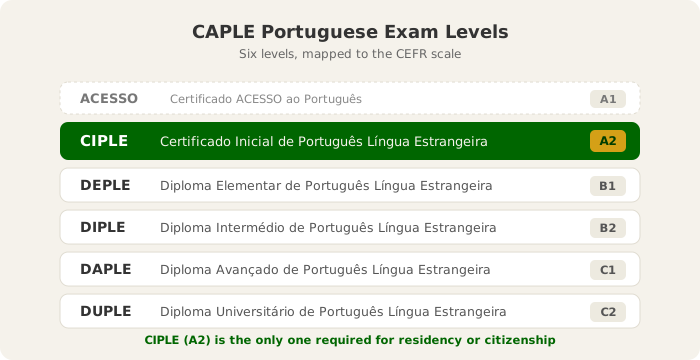
CAPLE actually offers six exams, one for each CEFR (Common European Framework of Reference for Languages) level: ACESSO (A1), CIPLE (A2), DEPLE (B1), DIPLE (B2), DAPLE (C1), and DUPLE (C2). ACESSO is less commonly offered; some testing centers skip it entirely.
For residency or citizenship purposes, CIPLE (A2) is the one that matters. If you already hold a certificate at B1 or higher, that satisfies the requirement too, so you wouldn't need to also sit the A2 exam.
When you actually need it
This is where some people get confused, understandably.
Your first residence visa, D7, D2, digital nomad, whatever the route, doesn't require A2 Portuguese. You can move here without it.
A2 comes into play later, at two points: permanent residency for non-EU nationals, and citizenship by naturalization. It's also sometimes requested for spouses or partners of Portuguese citizens, and for anyone applying through a Portuguese grandparent.
What changed in May 2026
Portugal's citizenship law changed on May 19, 2026. The residency period required before you can apply for citizenship went from five years to ten years for most nationals, and seven years for EU and CPLP (Portuguese-speaking country) nationals. The clock also now starts from the date your first residence permit is issued, not from when you applied. This matters if you spent time waiting for your AIMA appointment.
Here's the part that gets missed: the A2 language requirement itself didn't change. Neither did permanent residency, which is still five years for non-EU nationals. If permanent residency, not a passport, is actually your goal, this law doesn't move your timeline at all.
A new civic knowledge test was also added to the citizenship process, covering Portuguese history, culture, and how the country's government works. The details of how it's administered were still being finalized as of this writing, so treat that piece as evolving.
What's actually on the A2 test
Three parts, about two hours total:
Reading and writing (45% of your grade). Listening comprehension (30%), usually considered the hardest section, partly because the audio quality isn't always great. Speaking (25%), done in a small group, usually a short conversation or role-play.
You need 55% to pass. The exam costs €72, and it typically takes four to six weeks to get your results. So, if a citizenship or residency application is on your timeline, it's worth taking it earlier rather than at the last minute.
Getting to A2 isn't fast, and that's normal
If you've been studying and still don't feel ready, that's not a sign you're doing it wrong. People reach A2 anywhere from a few months to a couple of years, depending on time invested and whether they're actively practicing listening and speaking, not just memorizing vocabulary.
For context, Portugal's language bar is actually lower than several other European countries, which often ask for B1. By comparison, A2 is an achievable, tangible target.
Preparing on your own? Beware of apps that only teach Brazilian Portuguese - see why Duolingo might not be enough for your A2 exam.
This is general information, not legal advice. Immigration and nationality rules change often, and your specific situation matters. It is recommended to confirm current requirements with a qualified Portuguese immigration lawyer before making application decisions.
Want to understand more of what you're stepping into? Desenrascanço is the word Portugal uses for making it work anyway, even when it wasn't the original plan.
Portugal Speaks was built exactly for this kind of everyday Portuguese, not textbook drills. Real native-speaker recordings from Lisbon, focused on the situations you're actually in. Now live on the App Store and the Microsoft Store. Android is coming soon, so sign up to get notified the moment it's ready.